PR Pay
January 2026
GitHubTL;DR: To improve developer velocity at Coinbase, we built a pull request (PR) tool that incentivizes participation in the review process with cryptocurrency rewards. We also took home first place at the Coinbase Hackathon!
Motiviation
One of the core tenets at Coinbase is to move quickly and with velocity. Unfortunately, one of the realities of being a Software Engineer is that we often get deeply focused on our own work, and code reviews fall to the side.
For anyone who has worked in a technical role, you know how a stalled PR can seriously hurt a team’s momentum. Large PRs (or those opened by newer engineers) tend to sit even longer because they’re more time-consuming to review.
Because of this, we introduced PR Pay: a corporate platform that adds a monetary incentive for engineers to participate in reviewing their peers’ work.
Overview
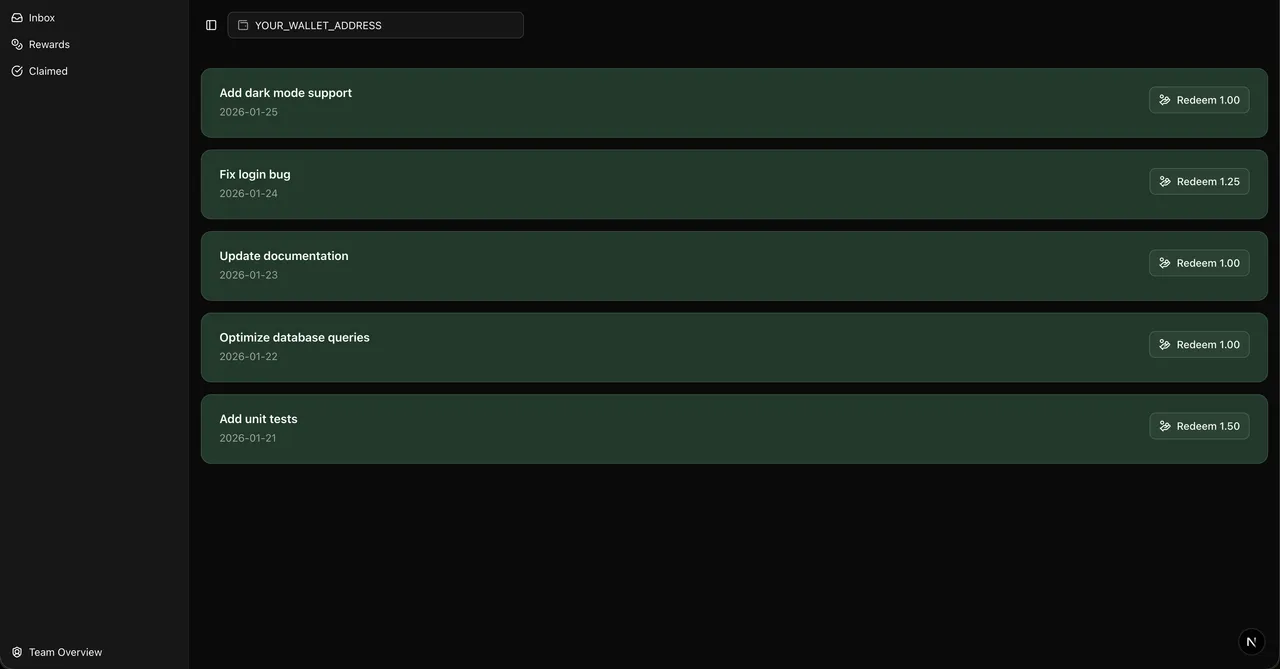
PR Pay monitors the creation, reviews, and merges of PRs published to a GitHub repository. As PRs are reviewed and merged, participants see claimable rewards appear on their dashboard.
Reviewers can enter their crypto wallet address to claim these rewards. PR status updates are handled automatically through the GitHub API and webhooks.
Use Case Interaction
- A PR is created on GitHub and assigned to Reviewer 1 and Reviewer 2
- A GitHub webhook notifies the backend that a new PR has been created with those reviewers
- Reviewers 1 and 2 both approve the PR
- The PR is merged, and the webhook informs the backend that the PR is complete
- The PR is displayed as claimable on the frontend for both reviewers
- Reviewers enter their crypto wallet address and claim their allocated payout
- The PR is moved to the “done” pile and archived

Technical Aspects
The stack for this project was simple and consisted of the following:
- Frontend built on NextJS & Shadcn
- Backend using FastAPI
- Supabase for OAuth and data storage
- Github Webhooks for collecting event data
Future Work
As a hackathon project, PR Pay was built quickly to validate the idea and prove out the core workflow. While not every edge case is covered yet, the platform is intentionally designed to be flexible and extensible.
There’s a lot of opportunity to evolve the incentive model, refine how value is measured, and expand how teams customize their programs. The foundation is in place to support more nuanced reward structures and better alignment with different engineering cultures and workflows.
Review Quality
A flat payout per review is a great starting point because it allowed us to ship fast and validate the core idea. Going forward, the system can support richer signals of review quality (such as comment depth, iteration cycles, or engagement metrics) to better reward thoughtful, high-impact reviews. This opens the door to encouraging not just fast reviews, but great reviews.
Governance
PR Pay is designed with transparency in mind. Using crypto wallets makes it possible to fund incentive budgets from a team-level source while still maintaining clear, auditable flows of rewards. With stronger observability at the team and individual level, managers can fine-tune their programs, promote healthy behavior, and ensure incentives stay aligned with company values.
Incentive Alignment
We recognize that not all PRs require the same level of effort. Larger changes, complex refactors, and onboarding-related PRs often demand more time and context from reviewers.
That’s why PR Pay supports a bonus payout mechanism, adding rewards on top of the base amount based on factors: size, revision count, or reviewer effort. This gives teams flexibility to match incentives to real-world complexity and better reflect the work being done.
Acknowledgments
- Chris Abboud : Worked with our backend’s Wallet to Wallet payments and redepmtion pathways.
- Rakesh Lingechetty : Implemented the PR and review state management for the backend.